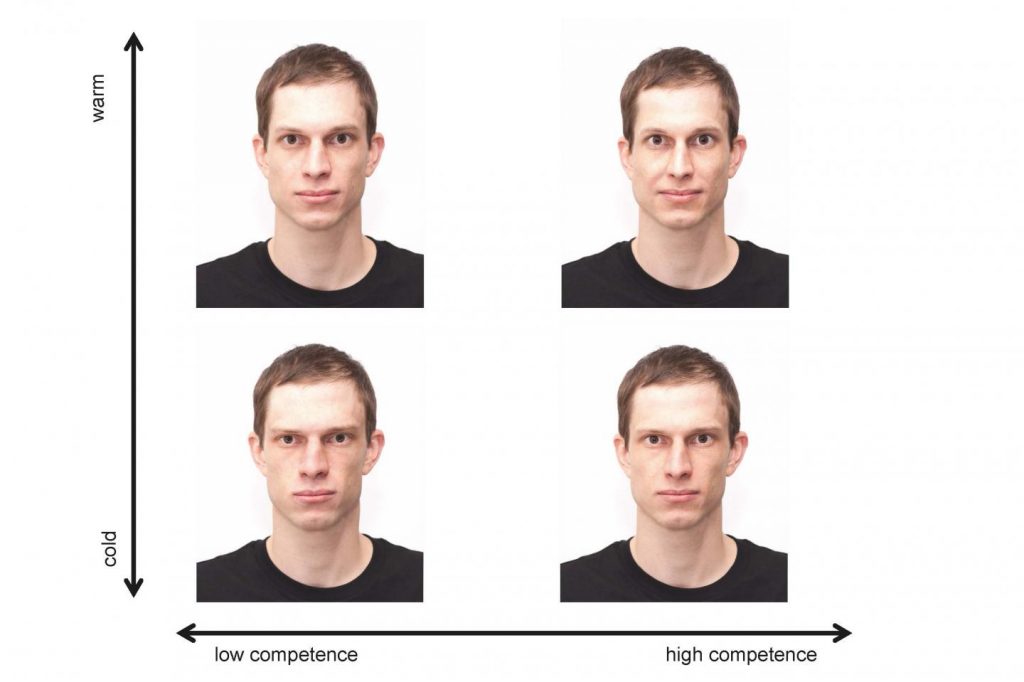
 People are often excluded from social groups. As researchers from the University of Basel in Switzerland report in the Journal of Experimental Social Psychology, whether uninvolved observers find this acceptable or not may depend on the facial appearances of those excluded. The exclusion of cold and incompetent looking people is more likely to be accepted.
Social exclusion – be it at school, work or among friends – is usually a painful experience for those affected. This behavior also often has a considerable effect on third-party observers: Bullying and ostracism with the aim to hurt the victims are seen as particularly unfair and morally unacceptable. However, in some cases, social exclusion is also perceived as justified. Groups are, for example, more likely to ostracize people who cause trouble or arguments in order to restore the harmony in their group.
Quick moral judgment
Whether uninvolved observers view social exclusion as morally justified or not can be very important for the victim as a possible intervention depends on that judgment. Making such a moral judgment, however, is often difficult and time consuming, which is why observers revert to relatively superficial indicators for guidance. One such indicator is the face of the excluded person.
In several studies, the team of psychologists from the University of Basel presented different male faces to a total of 480 participants. The facial characteristics had previously been altered using a recently developed method for facial manipulation. The portraits were manipulated to appear warm or cold and competent or incompetent. The participants looked at each portrait for two seconds before spontaneously deciding how acceptable they thought it was for a group to exclude this person.
More protection for warm and incompetent looking people
In all studies, participants found it more acceptable to socially exclude people whose faces looked cold and incompetent. However, exclusion was found least acceptable when those excluded looked warm and incompetent. A possible explanation for this could be that these people are often perceived as especially in need of protection and therefore excluding them from a group would be particularly cruel, says lead researcher Dr. Selma Rudert from the Center of Social Psychology at the University of Basel.
Earlier studies have shown that humans have very clear-cut ideas of what a warm or cold person looks like. However, there is no evidence for any relation between facial features and personality traits. In other words: Although appearances are deceptive, individuals let them guide their judgment. The perceived warmth and competence in a person’s face play an especially important role in this judgment.
Objectivity would be important
“Our results suggest that the first impression a person makes can also influence moral judgments that would actually call for objectivity”, explains Rudert. These impressions can have far-reaching consequences for how people behave in social exclusion situations: “It is conceivable that a cold and incompetent looking victim of exclusion would get less support or, in the worst case, bystanders may even actively join the ostracizing group – all based on one glance at the face of the victim.”
 The desire to punish those who’re disloyal toward the coalition helps keep disloyalty in check which in turn facilitates the evolution of the tendency to form cooperative coalitions.We frequently witness the human desire for justice, punishment and revenge not only throughout history but also in our day to day lives. When strict punishments are in place for those who fail to contribute their fair share, high levels of cooperation tend to emerge. Add to this the desire to harm slackers and those who’ve incurred a heavy cost on others. This, in common language, is called revenge. Studies have shown that people’s reward centres of the brain are activated when they punish or observe punishment of those who they think deserve punishment. Revenge is indeed sweet.
 By Melanie Tannenbaum for Scientific American