Social Engineering Blogs

An Aggregator for Blogs About Social Engineering and Related Fields

The Humintell Blog April 6, 2021

Benefits of Reading Facial Expressions of Emotion

The importance of nonverbal communication (NVC) and nonverbal behavior (NVB) are indisputable and there’s a vast amount of information that we can glean about individuals from them. But while all channels of nonverbal behavior are important, the most important is the face, and for good reason: the face is the most complex nonverbal signal system in the body, and it is used to express many different kinds of mental states.


Thus, no wonder we have face to face interactions, not elbow to elbow or butt to butt.

There’s good reasons why we look at each other’s faces when we interact: the face is the primary center of all that information above. And we are continuously processing that information when we interact with others.


What’s so Special about Facial Expressions?

Of all these signals, facial expressions of emotion are very, very special, because emotions are special types of psychological phenomena. As we’ve been discussing in our past few blogs, emotions are reactions to events that are meaningful for us. They are triggered by an information processing system in our minds that appraise or evaluate events that happen around us, and inside us. When triggered, emotions recruit an organized system of reactions that produce specific physiological signatures, direct our cognitions, and produce specific types of feelings.
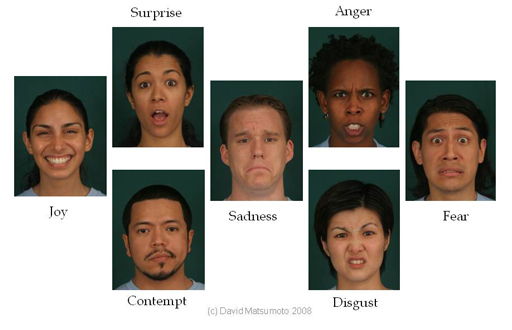
Importantly, emotions produce specific, nonverbal behavior in the face, voice, and body, and different emotions are expressed by different, specific, unique facial configurations that are universal to all cultures, regardless of race, nationality, ethnicity, religion, gender or any other demographic variable.


Benefits of Reading Facial Expressions of Emotion

  1. Facial expressions of emotion are probably the most important signal of the face because they tell us about people’s personalities, emotions, motivations, or intent.
  2. They are not only signs of people’s internal states; they are also signals to others to act in certain ways, providing messages for social coordination.
  3. They are also important signals of socialization and enculturation.

Facial expressions are also special because they can signal different, discrete emotions (otherwise known as the seven basic emotions or seven universal emotions) – anger, contempt, disgust, fear, happiness, sadness, and surprise.

As we’ve discussed previously, different emotions are associated with different antecedent and appraisal processes, and turn on different cognitive and physiological reactions in order to prime the body for action. Each discrete emotion signaled by facial expressions has a specific function, such as to remove obstacles, eliminate contaminants, or reduce harm.


A Window to a Person’s Mental States and Processes

When we read facial expressions of emotion, we don’t just read how others are feeling. Because of the characteristics of emotion described above and discussed in our previous blogs, facial expressions of emotion are windows to a person’s mental states and processes.

When we read someone’s facial expressions of emotion, we know

  • How their mind is processing something (antecedents and appraisals)
  • What their thoughts are turned toward (cognitive gating)
  • What their bodies are primed to do in terms of action (functions of emotion; physiological signatures)

gesture-triumph-children-computer

For example, if we read anger, we know that a person’s mind if processing goal obstruction, that blood is rushing disproportionately to their arms to prepare them to fight, and that their cognitions are gating to be aware of threat signals in others. If we read disgust, we know that a person’s mind is processing contamination, and their cognitions are gating towards eliminating contaminated objects. If we read fear, we know that their minds are processing threat, blood is rushing to their legs, and they are primed to flee or freeze.


The Science

Thus, reading each of the universal facial expressions of emotion is so important because when we read faces, we are actually reading the mind processing and evaluating stimuli. And when we see a specific, discrete emotion, we know how they evaluated something. We know the direction of what people are thinking, and equally important, we know what their bodies are primed to do doing before they do. Think about how important this is for people in harm’s way.
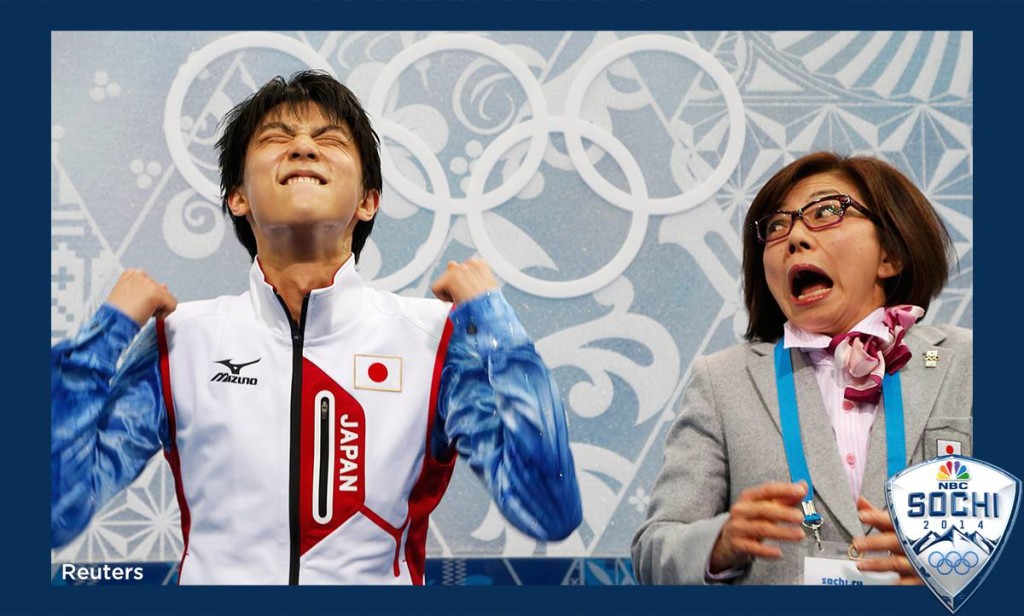
All this information that we can read from facial expressions of emotion allow us to get insights into the minds of the people with whom we interact, even when they are not talking. They allow us to draw reasonable inferences and testable hypotheses about people’s personalities, motivations, and intentions, which are incredibly important for many professionals.

When we observe facial expressions of emotion when people are talking, those emotional expressions give us important cues about how we should interpret the content of the words spoken. As with all nonverbal behavior, facial expressions of emotion can supplement, complement, qualify, or contradict spoken words, all of which are important moderators of how much as should infer from words alone.


Added Benefits of Reading Facial Expressions

There are additional benefits to being interested in reading facial expressions of emotion, too. Doing so shows interest in others by paying attention.

Ever observe or experience an interaction when people appear not to be interested in you or what you’re saying? And, catching emotion signals of others is a conversation starter or multiplier. It can be the basis for further discussion, including understanding others on an emotional level. Reading facial expressions of emotion is the basis for empathy. And because they’re universal, facial expressions of emotion are the closest thing we have to a universal language.

When we really think about it, we know why reading facial expressions of emotion is so, so important. These are the benefits of reading facial expressions, which you cannot get from reading any other channel of nonverbal behavior. That doesn’t mean that reading other channels is not important. But it does mean facial expressions of emotion are special, and the reason why we focus on it in our research and training.


For those of you have learned the basics of reading facial expressions of emotion with one of our online courses, challenge yourself to become even more skilled in reading them with other, more advanced courses.

For those of you have haven’t yet experienced learning to read facial expressions of emotion with one of our introductory courses, give it a shot! Now’s the time, for all the reasons above.

If you learn to read facial expressions of emotion and incorporate that skill into your professional practices, interviews, negotiations, sales, and the like, it will be a force multiplier like you’ve never witnessed.

The post Benefits of Reading Facial Expressions of Emotion first appeared on Humintell.

Filed Under: Emotion, Nonverbal Behavior

The Humintell Blog November 17, 2020

Why humans may have more in common with chimps than we thought

What can humans learn about ourselves from studying chimpanzees?

Primatologist Frans de Waal has spent almost three decades studying the behavior and intelligence of chimpanzees. Now, he’s focused on their emotional lives–and he’s found primates and people aren’t so different in how they react to circumstances and each other. Jeffrey Brown of PBS Newshour talks to de Waal about the implications of his findings.

The post Why humans may have more in common with chimps than we thought first appeared on Humintell.

Filed Under: Nonverbal Behavior

The Humintell Blog October 22, 2020

Threat Assessment Webinar Recap

Thanks to everyone who attended our Introduction to Threat Assessment webinar!

The session was held Tuesday, October 20th.

There were over 50 attendees from around the world, including many first responders.

We thank you for your service!


Dr. Matsumoto covered a variety of topics

He started with an overview of Humintell, who we are and what we do. Dr. Matsumoto explained the goals of the course and then an outline starting with an overview of threat assessment and nonverbal behavior. He reviewed three characteristics of all threats: motive, deception and reaction to context. In addition, he explained Humintell’s unique approach to behavior signature discovery for each of these three characteristics.

There was a significant portion spent discussing motives and research that has been done on this topic. Dr. Matsumoto highlighted one study he conducted that showed anger, contempt and disgust fuel hostility. The study was the first to show evidence of the connection between “ANCODI” emotions and aggressive behavior toward opponent groups.

From there, Dr. Matsumoto then moved on to explain different types of aggression and the importance of understanding and gaining a baseline. He explained there are different types of baselines including those in that are environmental (setting, flow of traffic, etc) and individual (which includes nonverbal expressivity and verbal expressivity). He stressed the importance of observing and identifying baselines around you and not ignoring anomalies.

Finally Dr. Matsumoto concluded by going over some behavioral signatures of imminent attack and introduced our Dangerous Demeanor Detector training. D3™ is a training tool that will help you identify individuals who are on the verge of dangerous actions. It is based on years of research conducted by Humintell, LLC, involving not only the general public but also law enforcement officers in different countries who have witnessed and/or been a victim of a physical assault, and remembered the face of the assailant immediately prior to the attack.

Because we have been able to isolate exactly which faces are associated with an impending attack, we can teach you to identify them. The purpose is to alert you of the need to be more on guard, and perhaps take protective action. D3™ trains you to be alert to both of these very different facial expressions. Learn more about Dangerous Demeanor here.

The session ended with a 15 minute live Q&A with attendees.


Missed this session? Don’t worry! You can purchase the recording.

LEARN MORE HERE

The post Threat Assessment Webinar Recap first appeared on Humintell.

Filed Under: Nonverbal Behavior

  • « Previous Page
  • 1
  • …
  • 6
  • 7
  • 8
  • 9
  • 10
  • …
  • 202
  • Next Page »

About

Welcome to an aggregator for blogs about social engineering and related fields. Feel free to take a look around, and make sure to visit the original sites.

If you would like to suggest a site or contact us, use the links below.

Contact

  • Contact
  • Suggest a Site
  • Remove a Site

© Copyright 2026 Social Engineering Blogs · All Rights Reserved ·