Social Engineering Blogs

An Aggregator for Blogs About Social Engineering and Related Fields

The Humintell Blog May 9, 2019

Not All Smiles Are the Same

While we tend to associate smiling almost exclusively with joy or happiness, this may lead us pretty far astray.

In fact, there are many different types of smiles and only a few can really be classified as happy smiles. As a recent article in the BBC outlines, of the perhaps 19 different types of smiles, only six indicate pleasant emotions. Instead, the remainder can designate contempt, anger, or even deception. If we want to effectively read people, exploring the differences between smiles is necessary.

One of these is, of course, the relatively well-known Duchenne smile.  This smile was identified as part of the 19th century experiments of Duchenne de Boulogne who sought to explore the underlying muscular configurations behind facial expressions. While he identified over sixty facial expressions, the Duchenne smile is perhaps his most famous discovery.

This expression, characterized by a wide, almost comically overblown, smile, is generally associated with genuine happiness and pleasure. Importantly, this expression is usually associated with “crow’s feet,” particular creases around the eyes. These crow’s feet are often seen as indicating genuine happiness.

Not all cultures encourage such open smiles. Instead, in Scandinavian, Russian, or Japanese cultures, overt smiles are frowned upon. This tends to lead to more “dampened smiles” where the mouth is slightly raised and the lips gently pushed together. While the mouth in these smiles is hardly affected, there is instead an emphasis on showing happiness through the eyes.

However, these sorts of genuine smiles are not the only kind of smile to be aware of. There is also the “miserable smile.” While this appears quite similar, it is usually asymmetrical and overshadowed by a grimace-like look of sadness. It was Humintell’s own Dr. David Matsumoto’s work which identified this smile among silver medalist athletes, including blind ones, suggesting that it is a universal expression.

There are also more concerning smiles to look out for. One of these is the “contempt” smile.  This expression combines both expressions of disgust and resentment but looks quite close to a genuine smile. Instead, it is similar in most respects but the corners of the lips remain taught rather than crinkled. This smile is especially common in East Asian cultures where overt anger is discouraged.

Similarly, there are fake smiles and blended smiles. In the former case, false smiles differ only subtly from the Duchenne smile. Unfortunately, these differences are hard to detect, as the Duchenne smile is easily faked. Testing the accuracy of a smile often demands that we compare it to other smiles that we have seen, ideally from the same person. It is the deviations from these norms that help determine if it is false.

Finally, blended smiles exist when people express a genuine Duchenne smile but layer on contempt, fear, or sadness. These smiles may look very similar but are tinged with clearly different intentions. This may be determined in a similar fashion to fake smiles but also by looking at whether a genuine smile even makes sense for that person in that context.

Hopefully, this gives some indication to how many different variations of smiles there are. It is important again to emphasize cultural differences here, as that can have a significant impact on what sort of smile is being displayed.

While it may be hard to take this information into the field, it might help get you starting on a people reading class or even a class dedicated to cross-cultural communication!

Filed Under: Emotion, Nonverbal Behavior

The Humintell Blog May 2, 2019

The Personality of Walking

Often in crowded cities, we clash with those who walk much more slowly, or we hold up those who walk faster. Is there an explanation for this variation?
According to a team of researchers, personality traits may help predict how quickly or slowly we will walk. In a creative study, published in Social Psychological and Personality Science, Dr. Yannick Stephan and his team looked at over 15 thousand individuals, tracking how quickly they walked and also measures of traditional personality traits like extraversion and neuroticism.

We rarely talk about walking speed, but isn’t it an important nonverbal behavior?

While past research has connecting walking speed to health, there are also compelling connections between personality traits and health. For instance, those high in neuroticism and low in extraversion tend to exercise less frequently and be in poorer health. While gait speed might not sound that important, this study attempts to further explore the relationship between our physical health and our personality.

For context, the researchers utilize a measure of five personality traits that has long been common in psychology. This includes neuroticism (a disposition towards negative emotions), extraversion, openness to new experiences, conscientiousness (a measure of organization and self-discipline), and agreeableness.

It might be suspected that data on gait speed would be hard to come by, but amazingly the researchers employed an incredible treasure trove of information on individuals’ personality traits and walking speeds. Some of this was even longitudinal, allowing an understanding of these relationships over time.

Overall, they found that personality features successfully predict walking speed, even when measured years before. They tended to find similar relationships even between different samples and age/demographic groups.

Extraversion and conscientiousness consistently predict higher walking speeds. This may seem intuitive, if we imagine an extraverted friend or someone who is quite self-disciplined. However, the opposite was true of neuroticism which declined more steadily over time and was associated slower gait speeds initially.

These findings are consistent with previous research finding the same connections between those personality types and health. By seeing how this is manifest in gait speed, a great deal of information can be inferred and further explored about how we express our personalities. Gait speed can then be used as a reliable predictor for both health and personality type, benefitting researchers, patients, and diagnosticians alike.

While this might seem a bit far afield from Humintell’s usual work, it really isn’t. Gait speed can be seen as an important nonverbal behavior!

Can you attempt to read people based on their pace? Rather than being in a hurry, they might just be really extraverted!

Filed Under: Nonverbal Behavior

The Humintell Blog April 4, 2019

Landmarks in the Field of Nonverbal Behavior

We spend a great deal of time talking about Humintell’s work on nonverbal behavior, but it’s important to know that this is a wide and exciting field!

In a recent paper in the Journal of Nonverbal Behavior, a pair of researchers sought to map out the major authors and major papers that have dominated the field. Instead of just looking at new developments, this was an important way of seeing what the lay of the land in the field is, so to speak, and this sort of work is incredibly valuable to those trying to expand the field and to those trying to understand the academic consensus.

One of the exciting features of this research was also an analysis of the most frequently cited and published scholars in the field. We were proud to see Humintell’s Dr. David Matsumoto listed in the top five scholars!

In mapping the discipline, Drs. Pierrich Plusquellec and Vincent Denault leveraged a massive bibliographic database that included more than 200 million articles from thousands of journals, not limited to psychology. However, they subset this database to a series of important keywords that were relevant to nonverbal behavior and folded in citation counts to each article to determine its importance.

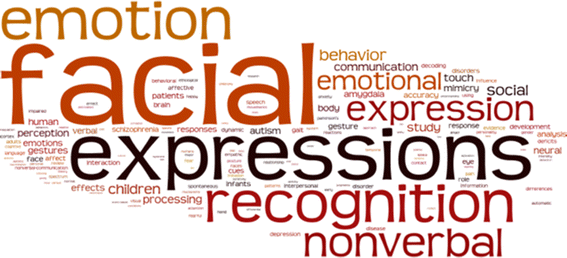
The first intriguing finding was a calculation of the most common words used in the titles of relevant articles. This tells us what most scholars tend to focus on and included “emotion,” “facial,” “expressions,” and “recognition.” However, these were often paired with applications including “children,” “psychiatric illness,” and “depression.”

Second, the study authors also tracked the frequency of highly cited articles over time. By looking only at the thousand most cited articles, they were able to track the development of seminal works and the emergence of increased interest in the field. They found that the field emerged during the 1960s but that most of these articles were actually quite recent.

This last finding indicates that, while the field has been developing for over 50 years, it has gained newfound emphasis and popularity recently.

These over-time findings were further explored by looking at how frequently used words over time, i.e. which words were most frequent during given decades. “Facial expression” tends to be one of the most frequent across the whole time period, though this was not so pronounced until the 1990s and 2000s.

So what exactly does this tell any of us about the field?

A main takeaway seem to be the primacy of studying facial expressions within nonverbal behavioral studies, which is notably different from looking at body language or even microexpressions more narrowly.

Another important conclusion is also the exciting nature of the current period of this field. It appears that the last 15 years have experience a sharp increase in interest, academic and otherwise, in nonverbal behavior, and we are optimistic that this trend continues!

Filed Under: Emotion, Nonverbal Behavior, Science

  • « Previous Page
  • 1
  • …
  • 17
  • 18
  • 19
  • 20
  • 21
  • …
  • 203
  • Next Page »

About

Welcome to an aggregator for blogs about social engineering and related fields. Feel free to take a look around, and make sure to visit the original sites.

If you would like to suggest a site or contact us, use the links below.

Contact

  • Contact
  • Suggest a Site
  • Remove a Site

© Copyright 2026 Social Engineering Blogs · All Rights Reserved ·