
Social Engineering Blogs

An Aggregator for Blogs About Social Engineering and Related Fields

The Humintell Blog June 18, 2020

Can Zoom Fatigue Be Related To Your Personality?

Since the Covid-19 pandemic hit, we’re on video calls more than ever before – and many are finding it exhausting.

There have been many articles addressing this “zoom fatigue” and the potential reasons for it. One reason often cited is the mental work and effort it takes to process nonverbal cues like facial expressions, the tone and pitch of the voice, and body language; paying more attention to these consumes a lot of energy. But can our exhaustion from remote meetings somehow be tied to our personality?

Many researchers today believe that there are five core personality traits that speak to the characteristics or qualities of an individual. These traits have been found by research to exist in humans all around the world, though the degrees to which people possess each trait differs.

One may find it helpful to use the acronym OCEAN (openness, conscientiousness, extraversion, agreeableness, and neuroticism) when trying to remember the big five traits.

Extraversion is one of these cross culturally universal underlying personality traits. A person who is extroverted is generally outgoing, friendly, sociable and happier more of the time than others. In contrast, a person who is introverted may be shy, quiet, reserved, and typically don’t seek out social events.

How introverted or extroverted are you? Find out here with a FREE test!

One suggested characteristic that’s associated with extroverted individuals is that when they meet people, they receive energy. When they meet people, teach classes, or socialize with others, they become energized. Whereas an introverted person uses energy when interacting with others, which can leave them drained. So how does this all relate to zoom fatigue?

Extroverted individuals may find themselves particularly drained after a remote meeting or class. Dr. Matsumoto suggests that although they may be interacting and seeing people they normally interact with, they’re likely not receiving the energy transfer they would in real life that normally invigorates them. Thus, these digital interactions leave them more exhausted than if the same interaction happened in real life.

The remoteness eliminates the interaction quality that allows them to give and receive energy.

Interestingly, there’s cultural differences in mean levels for extroversion as well. Americans generally have high extroversion, low neuroticism, higher conscientiousness, high agreeableness and high openness. Which means as a society as a whole, Americans may be suffering more from Zoom fatigue than other countries who have lower rates of extroversion such as Malaysia (see table below)
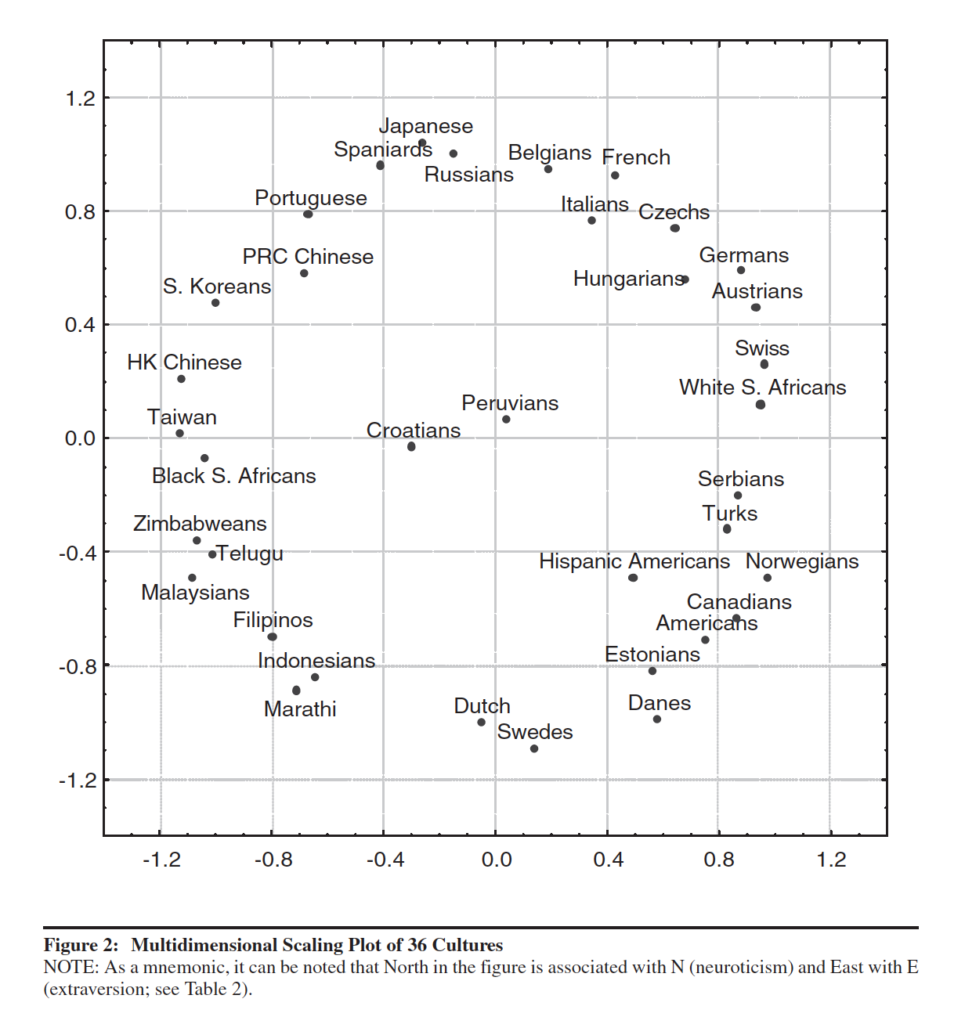
 

In addition to the many emotional consequences of digital communication we’ve covered, being remote may also eliminate the possibility of energy transfer we normally get in live interactions.

What are your thoughts? As an extrovert do you find this to be true? Let us know your thoughts in the comments section!


Want to learn more about the role of culture in shaping personality? View the video below to learn more!

Filed Under: Cross Culture, culture, Emotion, Introversion, Nonverbal Behavior

The Humintell Blog June 11, 2020

Why face masks make it so hard for us to express how we feel

Health workers rely on positive non-verbal communication to show care for their patients: close physical proximity, touch, head nodding, smiling, open body language and a focused eye gaze. It’s such an important part of the work they do, that the world’s largest nursing body, the UK’s Royal College of Nursing, has a section of its website dedicated to the importance of body language.

A doctor or nurse’s body language sets the trajectory for treatment from the moment the patient first sees them. Positive non-verbal communication has been shown to decrease patient anxiety and give better outcomes. And it gives the patient confidence that a physician is sensitive and understanding. As a result, the patient is more trusting and communicative.

Even with pain, patients who get high non-verbal support from their physicians show increased tolerance. Doctors’ detachment and distancing behavior — such as the absence of smiling and direct eye-gaze — has the opposite effect and is linked to worse patient outcomes. A recent study of 719 patients with the common cold found that the more empathic they perceived their doctor to be — the faster they recovered. Each patient was asked to score the doctor for empathy shown to them on a 1-10 scale. Those who scored the doctor a perfect 10 (around a third of patients) had reduced severity of symptoms, recovered faster and also had higher immune function, about 50% better than others.

Face coverings significantly limit a doctor’s ability to gauge a patient’s emotions. The masks can hamper health care workers’ attempts to provide non-verbal support to people in their care.

Not only that, imagine being alone in hospital, very ill and afraid, and the faces of the doctors around you are almost unrecognizable. This is the reality for so many in the Covid-19 pandemic. CNN explores the science behind facial expressions and why they’re so key to human interaction.

Filed Under: Emotion, Nonverbal Behavior

The Humintell Blog May 21, 2020

Emotional Consequences of Digital Communication

Video Call Facetime Chatting Communication Concept

Several weeks ago, we published a blog on how the recent shift from in-person to digital communication has changed the way we read people and their body language. We discussed how humans did not evolve to do 2-dimensional communication and that there are drastic differences in the nonverbal messages we receive in real-life versus digitally.

We’re now talking to people more than ever using digital platforms such as Microsoft Teams, Slack and Zoom. Last month, Teams reached 44 million daily users, up from 20 million in November. But what is gained and what’s lost through these types of digital communication? What are some of the long-term emotional implications of these types of interactions?

We sat down with Humintell Director Dr. David Matsumoto to discuss his thoughts on these issues.

Human emotions evolved to facilitate human social bonds

In real-life interactions, emotions arise as consequences of the interaction. In a live setting, as we are expressing ourselves verbally, we’re also emoting non-verbally. Simultaneously, we’re also perceiving each other’s verbal expressions (words) as well as their nonverbal behavior in total, some of which may be unconscious (including sights, sounds and smells). With all those receiving channels operating, it in turn elicits some kind of emotional reactions in the receiver.

Dr. Matsumoto believes that these reactions allow for the development of emotional bonds and connections among people. As humans, our whole communication package is not only about sending signals across all the modalities, it’s about receiving them in all the channels as well. Not only that, we’ve evolved for these emotional bonds to develop. This reciprocal exchange through words through language but also emotions and feelings and sentiments, non-verbally, is an important part of human interaction.

Mirror neurons are further evidence that receivers in an interaction are not passive clinical recipients. These neurons in the brain are specific to producing or mimicking other people’s expressions. And as result of them, interactants are actively processing information being received and then having thoughts, feelings and emotions triggered by what they’re perceiving.

These emotional, strong human bonds are critical to our evolutionary success.

They also play a part in our overall well-being. Strong social bonds have been proven to be beneficial to one’s life satisfaction and overall health. In addition, high levels of social support appear to buffer or protect against the full impact of mental and physical illness.

When using digital communication, there is a drastic reduction in our senses.

Including the loss of smells and sounds, we lose the complete nonverbal package we often get in real life. In addition, we lose the ability to read facial expressions of emotion as well as we would in a live setting; the observable contours, the wrinkle patterns and the shading of the face are greatly diminished. The amount of overall stimuli is greatly reduced.

Therefore, even though the empathetic response system of the body (including mirror neurons) may be turned on during digital communication, Dr. Matsumoto can’t see the thoughts, feelings, emotions in reaction to the other person are going to be triggered as to the extent they are in real-life.

As a result, with digital communication, we lose an emotional connection to the people with whom we’re interacting and there are several emotional consequences:

  • It’s difficult to develop strong relationships with others
  • It’s harder to maintain good relationships with others
  • It’s easier for existing relationships to degrade

Dr. Matsumoto states that there are potentially major social and individual consequences to this kind of exclusivity of interaction and recent research seems to back up his concerns. According to new research released by Well Being Trust (WBT) and the Robert Graham Center for Policy Studies in Family Medicine and Primary Care, the growing epidemic of “deaths of despair” is increasing due to the coronavirus pandemic—and they anticipate as many as 75,000 more people will die from drug or alcohol misuse and suicide.

So where do we go from here?

Having an awareness of these potential negative side-effects of digital communication equips us to insulate ourselves from such possibilities. Knowing these consequences can occur give us the gateway to then think about ways to mitigate and even counter such effects. Proactively planning around it and beyond it could be beneficial. For example, perhaps having longer discussions remotely or when safe, plan to have more in-person interactions with those you are close to in order to re-group what may have been lost.

Developing and maintaining relationships takes conscious effort and work. Devote your time and prioritize relationships that are important to you. Realize the importance of emotional and social bonds.

We are all going through this difficult time together. But if we remain cognizant of these potential negative consequences of digital communication and proactively plan for the future, we can overcome these challenges.

Filed Under: Emotion, Nonverbal Behavior

  • « Previous Page
  • 1
  • …
  • 10
  • 11
  • 12
  • 13
  • 14
  • …
  • 203
  • Next Page »

About

Welcome to an aggregator for blogs about social engineering and related fields. Feel free to take a look around, and make sure to visit the original sites.

If you would like to suggest a site or contact us, use the links below.

Contact

  • Contact
  • Suggest a Site
  • Remove a Site

© Copyright 2026 Social Engineering Blogs · All Rights Reserved ·