Social Engineering Blogs

An Aggregator for Blogs About Social Engineering and Related Fields

The Humintell Blog June 28, 2022

Screaming Conveys at Least Six Different Emotions

Why do people scream?

In non-human primates and other mammalian species, scream-like calls are frequently used as an alarm signal exclusively in negative contexts, such social conflicts, the presence of predators or other environmental threats.

Humans also use screams to signal danger and to scare predators. But new research suggests that humans scream not only when they are fearful and aggressive, but also when they experience other emotions such as despair and elation.

In the past, scientific studies on human screams have focused almost exclusively on vocalizations of anguish—and this oversight nagged at neuroscientist Sascha Frühholz. He and his colleagues set out to characterize the screams we let us for a range of emotions, negative and positive.

By studying screams recorded in a small, padded room, Frühholz and his team identified six acoustically distinct scream categories: pain, anger, fear, joy, passion, and sadness.

Their research was published in PLOS Biology.

The Study

As reported in National Geographic, the researchers recruited 12 volunteers to scream with each emotion. The volunteer was primed with a description of an emotion-evoking scenario for each scream type, such as getting attacked by a stranger in a dark alley.

Each person also recorded a “neutral scream” for comparison, which is just an intense utterance of “ahh.” They then instructed the participant to let loose in the soundproof room.

Frühholz and his team analyzed recordings of each scream by looking at 88 acoustic features, such as measurements characterizing pitch and intensity. They trained a computer algorithm on the various features that differed between screams and found it could correctly categorize screams nearly 80 percent of the time. The most accurate classification was for joy, with 89.7 percent correct classifications.

The team then studied participants listening to the recorded screams, measuring how quickly they could categorize the emotion triggering the scream by clicking an option on a computer screen.

In one set of trials, they tested people’s ability to select the scream type from all six emotions or neutral, and in another, the listeners only had the option of picking one of two scream types. The team also created maps of brain activity for people listening to playbacks of the screams using functional magnetic resonance imaging (fMRI).

They were interested in three particular brain systems in the fMRI scans, Frühholz explains.

  1. The first was the auditory system, which is involved in analyzing and classifying each sound.
  2. The second was the limbic system, which is involved in emotional responses, particularly during survival situations.
  3. Finally, the frontal cortex, which is involved in decision-making and helps put the sound in the broader context of a situation.

The Findings

The researchers found that volunteers more readily recognized—and their brains more efficiently processed—screams that were not considered alerts, including joy, passion, and sadness, compared to the screams of pain, anger, and fear.

They more slowly recognized screams from negative emotions, including pain, fear, and anger. Similar patterns also held for fMRI analysis, which showed non-alert screams sparked greater activity in listener’s brains compared to the alert screams. Exactly why, however, remains uncertain.

For all animal species, screams are considered a vital way to rapidly communicate danger to others nearby; why the joyful screams of this latest study seemed to invoke the strongest response remains unknown.

“The results of our study are surprising in the sense that researchers usually assume the primate and human cognitive system to be specifically tuned to detect signals of danger and threat in the environment as a mechanism of survival. This has long been supposed to be the primary purpose of communicative signaling in screams. While this seems true for scream communication in primates and other animal species, scream communication seemed to have largely diversified in humans, and this represents a major evolutionary step.”

Other Scream Research

Other research has been conducted on screams, including a study out of Emory University that found most people can’t tell the difference between screams of joy and screams of terror when they are heard out of context.

Unlike speech, the study finds screams lack distinctive and consistent acoustic parameters, which make them harder to identify. To see whether people could do so, researchers asked 182 participants to listen to 30 screams from Hollywood movies through headphones. Each scream communicated one of six emotions: anger, frustration, pain, surprise, fear, and happiness.

After hearing each howl, listeners then rated on a scale of one to five how likely the scream was associated with one of these six emotions. The results reveal participants correctly paired screams and emotions in most cases, except when it came to happiness. The group often confused these screams with fear.

“The acoustic features that seem to communicate fear are also present in excited, happy screams. In fact, people pay good money to ride roller coasters, where their screams no doubt reflect a blend of those two emotions.”

Interestingly, similarities between cries of joy and terror could have deep evolutionary roots. The findings may even provide a clue to the age-old question of why young children often scream while playing.

“Nobody has really studied why young children tend to scream frequently, even when they are happily playing, but every parent knows that they do. It’s a fascinating phenomenon.”

The post Screaming Conveys at Least Six Different Emotions first appeared on Humintell.

Filed Under: Emotion, Science

The Humintell Blog June 9, 2022

[STUDY] Do the Best Performers Give the Best Advice?

Everyone knows that if you want to learn how to do something, you should get advice from people who do it well, right?

In a 4-part study, researchers from Harvard University and the University of Virginia aimed to answer this question.

Their paper entitled “Tips From the Top: Do the Best Performers Really Give the Best Advice?” was recently published in the journal Psychological Science.

Part 1

In the first part of the study, around 1,000 participants (606 females; the average age of 35 years old) were asked to play Word Scramble. Participants were asked whether they thought there might be any link between how good someone was at the game and how good they’d be at helping others play it.

The answer?

Most people stated that someone’s ability to play the game would be an indicator of how good their advice was.

Part 2

In the second part of the study, 78 people (38 males; mean age of 36 years old) were chosen to be advisers to 2,000 more people who were tasked with playing the game. The advisers’ guidance varied, with some advisers saying people should look for short words, for example, or look for certain parts of words.

At the end of this part of the study, the researchers found that guidance did tend to improve people’s performance. However, they also found that the guidance that came from the best players was not actually any more beneficial to the new players compared to the guidance given from other advisers.


body languageDid you know?

The ability to read emotions in others and in oneself has proven through research to be the strongest driver of leadership and personal excellence.

A recent study even suggests people who are in tune with their colleagues’ emotions are more likely to bring home a bigger paycheck than their emotionally-stunted colleagues!


Part 3

The third part of the study switched things up again. This time, 300 people (152 males; mean age of 34 years old) were given the guidance written by advisers in the previous part but were told not to implement them into the gameplay. Rather, they were asked to simply guess how effective the guidance would be.

It’s crucial to note that the players who were given the advice were told nothing about the performance of the people who gave it.

The results showed that the guidance provided by the most successful players was regarded as sounding better than the guidance provided by the rest—even though the previous part of the study (part 2) showed that this advice was not actually any more effective in practice.

Part 4

The fourth and final part of the study did not involve any gameplay. In this section, researchers analyzed the advice given by the more successful players to see why people rated it more highly. They found that the more successful performers made a higher number of suggestions than others.

“The best performers did not give better advice, but they did give more of it, and participants apparently mistook quantity for quality,” the study reads. “These studies suggest that performing and advising may often be unrelated skills and that in at least some domains, people may overvalue advice from top performers.”

Although advice from the best-performing advisors was no more beneficial than advice from other advisors, participants believed that it had been—and they believed this despite the fact that they were told nothing about their advisors’ performance. Why?

The best performers did not give better advice, but they did give more of it, and participants apparently mistook quantity for quality.

These studies suggest that performing and advising may often be unrelated skills and that in at least some domains, people may overvalue advice from top performers.

The post [STUDY] Do the Best Performers Give the Best Advice? first appeared on Humintell.

Filed Under: Emotion

The Humintell Blog May 3, 2022

What’s the Difference Between Emotions and Feelings?

Emotions and feelings are often confused with one another, but how do they differ?

What are feelings?

Feelings refer to the perceptions of sensations that are felt in the body. There are many processes that take occur in our bodies that can create sensations. Our perceptions of those sensations constitute what we know of as feelings.

Because there are processes that are going on in our bodies all the time, we can perceive those sensations all the time.

It is important to note that there are large individual differences among people on how perceptive they are to those sensations. Some people are very perceptive whereas some people are not.

Feelings can be related to emotions. For example, we can have angry feelings and sad feelings. However, we can also feel cold, feel hot, feel tired, and feel hungry.

What are emotions?

Emotions are a special class of mental phenomenon where they are reactions to events that have special meaning to us.

Emotions are reactions to meaningful events and emotional reactions include cognitive and physiological changes. These changes occur in our thinking and perceptions as well as in our physiology. All of which help prime our bodies to act in a certain way.

Because these changes involve cognition and physiology, they also creation sensations in us that we can perceive. Since we’re perceiving these sensations all the time, we also have feelings when we’re emotional. In fact, we can have unique and strong feelings when we’re having an emotion. Thus, many people equate feelings with emotions.

In reality, feelings are one component of emotion (along with others) and feelings go on all the time. You can have non-emotional feelings and they generally are continuous readouts of our internal states. Emotions are specific reactions to certain events that include feelings.

Why do we have emotions?

Emotions help us react in some situations with minimal conscious awareness. They help us freeze or flee when there’s an immediate danger, to fight when there’s an obstacle to our goals, or to repel spoiled, rotten, or contaminated things, like spoiled milk, before we ingest them.

Thank god we don’t go through such time consuming, risk-benefit calculations for many life or death events and situations – those that have implications for our health or safety. Those with that system survived and remain here today; those without that system were selected out of existence by nature.

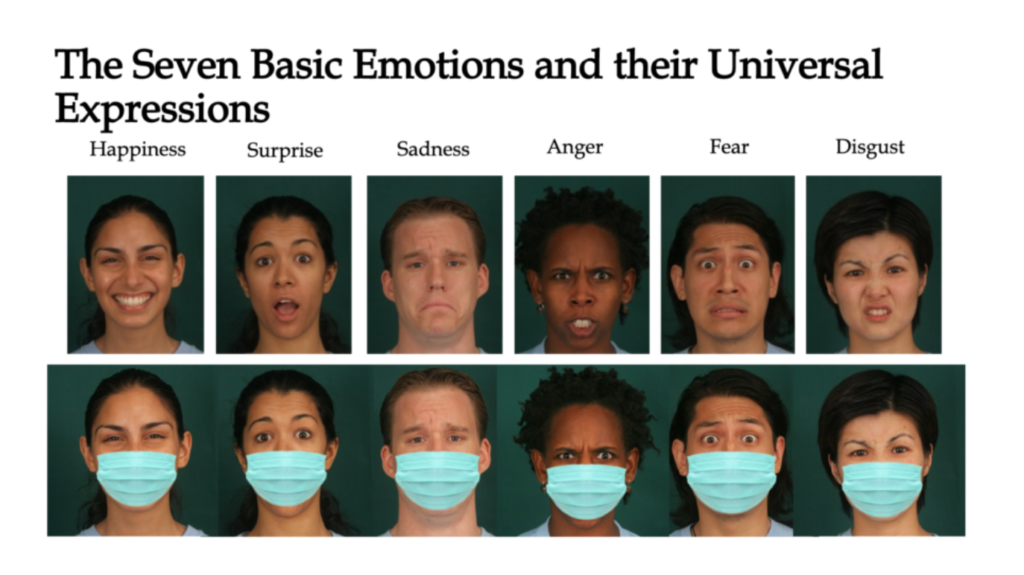
We’ve discussed how each of the basic emotions are triggered by a universal, underlying psychological theme. In the very same way, each of the basic emotions have a unique function, that is, each helps us do something fairly specific. All of these aid us ultimately in our survival. Thus, getting a handle on the function of each of the basic emotions gives us an idea of why we have each of these emotions in the first place, and what roles they played in getting us here.

Here’s a brief list of the functions of each of the seven basic emotions that are universally expressed:

For more on how emotions help achieve these functions, read this past blog post!

How many emotions are there?

One of the biggest misunderstandings about the 7 universal facial expressions of emotion is that people think that means we have only seven emotions. Nothing could be further from the truth.

Yes, facial expressions of anger, contempt, disgust, fear, happiness, sadness and surprise are universally recognized and expressed. But humans have many other types of emotions as well. These include pride, shame, guilt, embarrassment, triumph, worry, hate, love, jealousy – the list of emotions goes on and on.

This poses a dilemma. On one hand, decades of science have demonstrated that there’s a special category of emotions known as basic emotions. As we have discussed previously, different scholars classify different emotions into their list of what’s “basic.” We use universal, observable, nonverbal signals in the face as our criterion for classifying emotions as basic, which is why we believe there are 7 basic emotions. Other scholars have other approaches. Basic emotions are not necessarily better; they’re just different.

On the other hand, a quick search of emotion words will reveal that there are hundreds of emotion-related words in English. And this is true in all other languages as well. We can relate to all those emotions lists; they’re all important to our everyday social lives.

To learn how we can reconcile this dilemma, read this past blog post!

The post What’s the Difference Between Emotions and Feelings? first appeared on Humintell.

Filed Under: Emotion

  • « Previous Page
  • 1
  • …
  • 10
  • 11
  • 12
  • 13
  • 14
  • …
  • 69
  • Next Page »

About

Welcome to an aggregator for blogs about social engineering and related fields. Feel free to take a look around, and make sure to visit the original sites.

If you would like to suggest a site or contact us, use the links below.

Contact

  • Contact
  • Suggest a Site
  • Remove a Site

© Copyright 2026 Social Engineering Blogs · All Rights Reserved ·