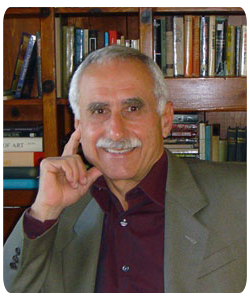
 I owe Albert Mehrabian, Ph.D., an apology. I suspect a lot of other people do as well. Dr. Mehrabian is a Professor Emeritus of Psychology at the University of California, Los Angeles (UCLA). He garnered widespread attention for his research in the area of non-verbal communication in the 1960s. If you’re in business then it’s very likely you’ve been exposed to his work. Here’s what you might have heard or read: In face-to-face communication only 7% of your message is based on what you say. Your tone of voice accounts for 38% and your body language is 55%. On the phone it’s 13% words and 87% tone of voice.This prompted many people – me included – to place too much importance on tone of voice and body language during communication training. It’s not bad to work on those areas to make your communication more effective. The problem is that it has us putting too much emphasis on tone and body language.It’s amazing how a story told from a speaker platform, mentioned in a book or noted on a blog is simply taken as gospel. After all, that well-respected speaker, author or blogger wouldn’t make such a glaring mistake … would he or she? I certainly did.I’ve come to understand nearly everyone of us has misinterpreted and misapplied Dr. Mehrabian’s work. This came to light a few weeks ago when I wrote about The Importance of Congruent Messages When Persuading. At that time I also saw a social media post from a friend that prompted me to read more about Dr. Mehrabian and his work. Here’s what I found.
 Dr. Mehrabian’s work very specifically had to do with communicating feelings and attitudes. If subjects felt there was inconsistency between a person’s words and tone or body language then they took more of their cues from the tone and body language. An example would be an apology. Two people can use the very same words and one person might be whole-heartedly believed while the other might not. It’s easy to utter the words but if the apology is not sincere it’s very likely the tone of voice, facial expressions or other body language might convey a different message. You can probably think of a time where someone said the right words but you knew they didn’t mean it because of other cues you picked up on.On the other hand, if you go to a presentation about home ownership you’re probably not assessing – consciously or unconsciously – the believability of the message based on the speaker’s tone of voice or body language. If you contend with anything it will most likely be the facts (words) he or she uses during the presentation. There’s little in the way of attitude or feelings to be assessed in such a fact-based presentation.So now what? By all means, don’t discount tone or body language when communicating because both can enhance your presentation tremendously. As I’ve worked on voice inflection and body language over the years I know my presentation skills have improved significantly. But don’t forget, content is king in most presentations. You don’t want to leave a meeting and have people remember what you wore but not what you said. After all, the reason for a meeting or presentation is to convey ideas so everything you do should enhance the message. Let me conclude by saying I’m sorry, Dr. Mehrabian, I really am. I’ve learned a good lesson and hope you can forgive me. If you could hear me and see me I’m sure you could tell my tone of voice and body language are in line with my apology. My 7%-38%-55% messaging is congruent.
 Brian Ahearn, CMCT® Chief Influence Officer influencePEOPLE Helping You Learn to Hear “Yes”. Cialdini “Influence” Series! Would you like to learn more about influence from the experts? Check out the Cialdini “Influence” Series featuring Cialdini Method Certified Trainers from around the world.
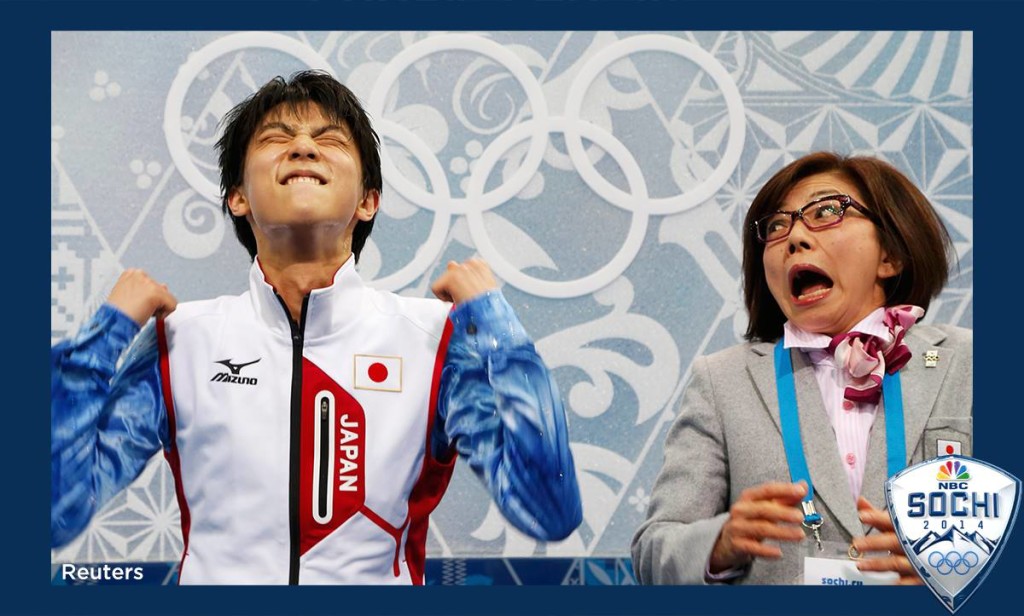
Sochi Winter Olympic Emotions
A great photo to analyze nonverbals. What does this photo say to you? Japan’s Yuzuru Hanyu (and his coach’s) reaction to his world record setting figure skating short program score at the 2014 Sochi Winter Olympics.
3 Greatest TED Talks To Persuade
A little while ago I was asked what are the Greatest TED Talks people should watch if they want to become more persuasive. If you don’t know TED is non-profit organisation devoted to amplifying electrifying ideas from the domains of technology, entertainment and design (TED) and provide the TED and TEDx conferences and publish their talks for free to inspire change. The three TED talks I have selected to share are simply in my humble opinion three of the Greatest TED Talks that have impacted my thinking and how I go about persuading others.
First is Seth Godin and his talk on How to Get Your Ideas to Spread.
Next is Simon Sinek and his hit talk – How Great Leaders Inspire Action – Start With Why.
Finally Rory Sutherland and his talk Life Lessons From An Man
What are the Greatest TED talks you have watched that have impacted on your ability to influence others.
The post 3 Greatest TED Talks To Persuade appeared first on Social Influence Consulting Group.
- « Previous Page
- 1
- …
- 347
- 348
- 349
- 350
- 351
- …
- 562
- Next Page »