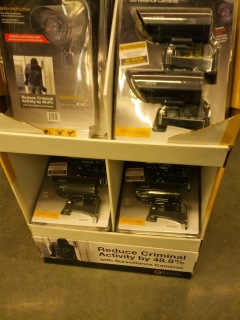
I can’t even begin to tell you how many times I run into stores that have decoy cameras in lieu of real cameras. I also can’t tell you how many countless times these same stores get robbed. Buying a decoy camera, in my opinion, are invitations for criminals. This is not to say most criminals can’t tell the difference between fake and real. This is to say that many of these businesses and homes that utilize decoy cameras don’t quite get what kind of mitigators they need to adequately protect themselves and their assets.
The added statistic at the bottom of this photograph is especially troubling because it dupes customers into believing they have added another layer of “security”. This is correct in some respects. Remember what I said about “security” being a goal and less of an action? The problem lies in exactly the same place issues of semantics in security are – it relies on data that is either incomplete and more than likely, irrelevant to their protection needs.
We all know cameras serve a variety of purposes other than video surveillance. We also understand some vendors and property owners either have poor tools or are so under-trained they may as well not have a camera. However, when an incident happens, the last thing property owners want to tell the police and insurance companies (worse yet, a jury in a civil liability trial) is they thought a decoy or non-operative camera offered better protection.
If you’re a property owner and considering one of these decoys, turn around and invest in a camera system you will monitor and maintain. If you’re a pro, call these out and the dangers behind using them.
Filed under: Crime Mitigation, Security Management 



 Last month I hosted a webinar on the principle of scarcity for the Cialdini “Influence” Series. During the 30-minute webinar I introduced participants to the ethical application of scarcitywhen it comes to managing salespeople and increasing sales. If you’ve followed this blog for any length of time then you know scarcity is the principle of influence which alerts us to the reality that we place more value on things when they’re rare or becoming less available. We see this principle at work constantly: Advertising – Perceived limited time or limited availability gets customers to act in ways they wouldn’t otherwise.Relationships – When we lose someone we love we often wish we’d done more for them or with them. The mere thought of losing someone could change our behavior.Work and School – Deadlines drive much of our prioritization and activity when it comes to school or work.I’m sure you can think of your own examples where you’ve seen your behavior influenced by this psychological principle. What I want to explore is a question that came up as the webinar was ending. Someone asked if personal preference played into scarcity’s effectiveness. It was a great question, one I’d never considered before. The example that came immediately to mind as I pondered the answer was something from my childhood.When I was young I collected baseball cards. This goes way back to the days before you could buy whole sets of cards. Kids got their baseball cards when they bought the bubblegum packs with cards inside them. From there we traded to round out our collections. I still remember the most famous card was the 1909 Honus Wagner. Although neither my friends nor me knew anything about Honus as a player we knew there were only six in existence and that made it the most valuable card. The card is reportedly worth $2.8 million today!
 Certainly anyone reading this would love to have that card but for the most part baseball cards are only valuable to those who collect them. When I showed one of my old cards to Jane and told her it was worth about $200 she said, “Hmmm, four pairs of shoes.” She could have cared less that my Ted Williams 1956 Topps baseball card was in very good condition and she never would have paid $200 for the card because baseball cards mean nothing to her.Much like beauty, scarcity is in the eye of the beholder. For example, hearing a furniture outlet is having a half price sale that ends Sunday will do nothing to incent my behavior if I’m not considering getting new furniture for my home. A large part of selling is contacting qualified prospects. Qualified prospects are those people or organizations that are in the market for what you sell. When a prospect realizes they may lose out on a great opportunity that could fulfill their need, quite often scarcity will impact their decision to act. Another category of qualified prospects would include people or organizations that might not see their need for what you sell unless you can arrange to meet with them and show how your product can positively impact them. Once you’re talking with this type of qualified prospect, introducing scarcity might be enough to get them off the fence to make a decision. In the Principles of Persuasion workshop I emphasize this point – scarcity is best used to motivate behavior. If you’ve already established some relationship and the prospect isn’t unsure about what to do – they’re just not making a decision – then scarcity can be just the thing to get them over the hump. However, just indiscriminately telling people they’ll lose something by not acting when they could care less about what you’re offering is a recipe for failure in sales. Here’s my sales advice – really get to know your current and prospective clients. Understand their business and their needs so you can match your product offering accordingly. Once you’ve done that, when you have genuine scarcity make sure you introduce it during the sales process because that might be just the thing that helps you make the sale.
 Brian Ahearn, CMCT® Chief Influence Officer influencePEOPLE Helping You Learn to Hear “Yes”.Cialdini “Influence” Series! Would you like to learn more about influence from the experts? Check out the Cialdini “Influence” Series featuring Cialdini Method Certified Trainers from around the world. Next up is Hoh Kim talking about Authority on April 17.