Social Engineering Blogs

An Aggregator for Blogs About Social Engineering and Related Fields

The Truth About Deception Blog February 7, 2015

Good Lovers Lie

If you are honest with yourself, you are probably aware that when it comes to love – the truth is necessary, but so too are lies.

A quote from Clancy Martin in a NYTimes piece on the topic:

“Love is a greater good than the truth. No marriage, no parent’s love of a child should be scrutinized like a pathologist examining his cadaver. Save your ruthless pursuit of the truth for the laboratory; we lovers would rather be like Shakespeare: “Therefore I lie with her and she with me / And in our faults by lies we flatter’d be.” Don’t worry so much about ferreting out the truth. Take care of each other instead.”

And similar quote from a difference source:

“When you take a step back and put it altogether, the picture that emerges about intimate relationships is somewhat contradictory: Because our romantic relationships are so rewarding, yet so constrictive, we are simultaneously more truthful and more deceptive with those we love. Additionally, we place the most trust in the person who is most likely to deceive us, just as we are most likely to deceive the person who loves and trusts us the most. These are just a few of the paradoxes that emerge when taking a close look at the use of deception in our romantic relationships.”
Filed Under: Deception

The Humintell Blog February 6, 2015

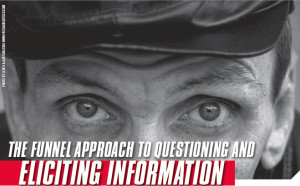
The Funnel Approach to Questioning and Eliciting Information

2015-02-06_13-25-16Written for Tactics and Preparedness, Issue 15, January 2015

By Dr. David Matsumoto, Dr. Hyisung Hwang and Vincent Sandoval

Broadly speaking, elicitation refers to procedures or techniques involving interacting with and communicating with others, formally or informally, that is designed to gather knowledge or inform. Eliciting information from anyone who is uncooperative is a difficult task. Elicitation can occur in many different contexts, including very impromptu, informal situations such as everyday conversations and social interactions (e.g., a “chance” meeting at a cocktail party or other social gatherings) or very formal ones that are scheduled and occur in a predefined place (e.g., a job  interview). In this article, we provide tips to eliciting information during relatively more formal interviews, which we define as an overt activity for the purpose of information gathering. That is, an interview is a conversation with a purpose.

A list of questions by itself does not constitute an interview. Instead, one should prepare for interviews by crafting relevant questions to address specific topics to explore with the subject prior to conducting an interview. Preparation is essential to effective interviewing, including conducting and analyzing background reports, collating corroborating or disconfirming information, interviewing other individuals, gathering relevant forensics and other physical evidence.

Even when it comes to the interview, there are many things to consider, and it is important to understand the interview within the broader context than just the interaction between interviewer and subject. Interviews occur in a certain place and time, between two or more individuals who often come from very different backgrounds, cultural perspectives and goals. Sometimes subjects (and interviewers) come to the interview with deep-seated hatred and disrespect for each other. In many instances subjects may be uncooperative or cooperative up to a point. Interviews take place in a specific setting and much consideration needs to be paid to configuring those settings to maximize the effectiveness of the interview.

Effective interviewers rarely just jump straight to the point of the interview at the outset by asking very direct questions
about a very specific topic. Instead, effective interview strategies involve the development of some degree of rapport between the interviewer and subject. The development and maintenance of rapport can be very tricky and demanding, especially with an initially uncooperative subject. Establishing rapport needs to be part of an effective interview strategy.

There are many different types of interview strategies and tactics. Below, we provide some broad-stroked tips based on our
knowledge of the existing science relevant to interviewing as well as what has been vetted in the field with years of experience, which can be flexibly applied to a variety of settings.

Continue reading this article by clicking here

Filed Under: Communication, Nonverbal Behavior

studunnblog February 5, 2015

Chapter 19; True Lies

CHAPTER 19 – Relationships (last chapter in True Lies)

  “Failure to recognise each other’s separate existence is the major source of conflict between partners” – Harville Hendrix

Introduction

IMG_2351Throughout all of my studies of human behaviour, the subject that I discovered I was least proficient in was my own relationships. Somehow I managed to kid myself about my inability to understand the wants and needs of a significant other over the years, perhaps due to my background and that I generally pride myself on my communication skills?

Each relationship ended with my believing that I was right and their perspective was wrong. I truly believed that I knew better.

The shift in the way I saw relationships came in several ways. Meeting Bridget was one. We both made a commitment to learning how to better communicate with each other (as at the time we had perfected how not to communicate effectively). The next step in my journey was taking a road trip and listening to the entire 7 Habits of Highly Effective People CD set (not for the first time) by the late Stephen Covey. And finally, the third shift in how I saw relationships came while reading Harville Hendrix’s book, Getting The Love You Want. This combination created a complete shift in how I was looking at relationships, and I could see where I had gone wrong in the past prior to meeting Bridget.

I have placed this chapter at the end of the book, because I believe that in the end, everything is about relationships. It took me a long time to realise where I was going wrong, and once I finally experienced my paradigm shift, I felt the need to share at least some of what I learnt. It is my hope that people reading this chapter will gain renewed hope (where needed) for their own relationships, as well as providing some ideas of what to do to move forwards.

Relationships are like seasons in the sense that they go through stages that include romantic love, experiencing connection, fights and ruptures, repairs and make ups, then back to romantic love once more.

How Do We Pick Partners?

Something that I found most interesting was the cycle in relationships, when – once the person breaks up – claims that their ex-partner was just like the one before. Why is it that people are generally attracted to a certain type?

“We always marry someone for the purpose of finishing our childhood.” – Harville Hendrix

DSC_8297According to Hendrix (2008) if you write down three positive and negative traits of your parents (or caregivers) on one page, and then do the same for your partner – you will discover several things (this is very simplified). First, your partner will likely share similar positive and negative traits to at least one of your parents. Secondly, the negative traits in each person should give you some reflection of some of your own negative traits that you do not like.

Relationship Observation #1: Most of your partner’s criticisms of you have some basis in reality (Hendrix, 2008).

There is also a strong likelihood that the complaint is something from the person’s childhood; for example the criticism from your partner that you are disorganised could stem from a parent or primary caregiver being disorganised and upsetting you as a child.

Romantic Love

Romantic love can be described as “a state in which a partner in a committed relationship assumes and lives as if his / her partner shares the same experiences and beliefs about the world.” What actually happens is during the attraction phase of a relationship, is that the brain releases dopamine and norepinephrine (two of the body’s many neurotransmitters) that help contribute to a “rosy outlook on life”, a rapid pulse, increased energy and a sense of heightened perception. During this phase (when lovers want to be together every moment of the day) the brain increases its production of endorphins and enkephalins (natural narcotics) which in turn enhances a person’s sense of security and comfort. There is also some evidence that there is an increase in the neurotransmitter serotonin (Hendrix, 2008).

“The meeting of two personalities is like the contact of two chemical substances: if there is any reaction, both are transformed.” – C.G. Jung

Unfortunately the brain in not able to continuously pump dopamine and serotonin into our bloodstreams, therefore the “romantic love” phase is not designed to last. This stage of the relationship cycle is how people attract and bond with each other in order to be able to better deal with the rougher times.

Power Struggle

Hendrix (2008) suggests that the power struggle first occurs once a couple makes a real commitment to each other. Some time afterwards one or both partners begins to believe that the other has changed in some way (common comments are sayings such as; “You’ve changed” or “If you really loved me you’d know the answer”), which disrupts the connection made in romantic love.

“When we experience conflict, we experience fear, isolation and loss of awareness of connection, but not the fact of connection. Separation is an illusion.” – Hendrix

Couples can feel disillusioned and frustrated with their partners during the power struggle, with a lot of relationships breaking up during this stage.

Relationship Observation #2: Many of your repetitious, emotional criticisms of your partner are disguised statements of your own unmet needs (Hendrix, 2008).

Have a think about this one, and ask yourself; “In what way are my common criticisms of my partner also true in me?” This follows the perspective that when you point a finger you have four pointing back at you – what can you learn about yourself in what you find most challenging in your partner?

“People are lonely because they build walls instead of bridges.” – Joseph F. Newton Men

Choose a Conscious Relationship

A IMG_8226Having an unconscious relationship infers that things happen without thought. That fight happened because they did this or that. They made me angry. Being in this space encourages blame and putting the other down or making them wrong. A conscious relationship however is taking ownership of your own behaviour, your own emotions, reactions and triggers. You become accountable for your actions, you intentionally work together, and ensure that each is heard and understood (as with body language, there is also a sender and receiver with verbal communication). You understand that each person has a valid perspective; and as their perception is different, take the time to investigate their point of view remembering that the key difference between sensation and perception is interpretation. Learn how to mirror each other. Validate what is being communicated by one another to ensure the intended message (from the sender) has been received as intended without incorrect interpretation (by the receiver). Learn how to empathise with each other.

Relationship Observation #3: Not being heard or feeling misunderstood is a great cause of conflict between partners (Hendrix, 2008).

I get frustrated when what I say isn’t interpreted as I’d intended it, the wrong message is received. Every person is different, with unique experiences and perspectives. Therefore, when you come across this, ask your partner to tell you back what you just said. No Criticism. No judgment. Just ask; “Can you please paraphrase back to me what I just said, so I know you got what I meant?”

Closing Exits

Exits are what Hendrix (2008) refers to as behaviours that reduce or avoid involvement in your relationship. There are normal function exits such as work, and then there are intentional exits (also referred to as “the invisible divorce”) that involves intentionally avoiding your partner. An example would be going to work (a normal functional exit), however knowing that things are not great at home and deciding to stay later at work, go out for drinks, start a new hobby or sport etc – these are all intentional exits. Other common intentional exits include reduced alone time with your partner, for some it may be television, others computer or games, perhaps the gym, or maybe reading. When things are not going well in a relationship, it is necessary to find the areas where you may be intentionally reducing or avoiding direct involvement in your relationship.

Identify them, and then work together to decide which exits can stay and which are unnecessary. Perhaps exercising is extremely important to you, therefore keep it. Maybe, however, watching three hours of television each night and going to bed when your partner is already asleep could change?

“Coming together is a beginning; keeping together is progress; working together is success.” – Henry Ford

Relationship Myth: If you fight a lot with your partner you must be with the wrong person. Myth! Conflict is an opportunity to grow, and most “healthy” conflict allows this growth within relationships. It is when the conflict becomes damaging that something needs to change.

“Every word, facial expression, gesture, or action on the part of a parent gives the child some message about self-worth. It is sad that so many parents don’t realize what messages they are sending” – Virginia Satir

Love Languages

Another book I found interesting was Gary Chapman’s The Five Love Languages (Chapman, 2004). Again following along the sender and receiver perspective, Chapman (2004) suggests that there are five different ways in which people express love (quality time, words of affirmation, gifts, acts of service and physical touch), and the key to a healthy relationship is to understand not only how you receive love best yourself, but how your partner receives love. You buy your partner a gift when all they really want is quality time together. Learning how each of you receives love will help you to send more personalised “messages” to your partner. Find out your love language by visiting: http://www.5lovelanguages.com/profile/

Did You Know? The word “rapport” means “sympathetic relationship, have affinity with, harmony” (Concise English Dictionary).

“Some of the biggest challenges in relationships come from the fact that most people enter a relationship in order to get something: they’re trying to find someone who’s going to make them feel good. In reality, the only way a relationship will last is if you see your relationship as a place that you go to give, and not a place that you go to take.” – Anthony Robbins

Filed Under: help, Influence, love, relationship, romance

  • « Previous Page
  • 1
  • …
  • 254
  • 255
  • 256
  • 257
  • 258
  • …
  • 562
  • Next Page »

About

Welcome to an aggregator for blogs about social engineering and related fields. Feel free to take a look around, and make sure to visit the original sites.

If you would like to suggest a site or contact us, use the links below.

Contact

  • Contact
  • Suggest a Site
  • Remove a Site

© Copyright 2026 Social Engineering Blogs · All Rights Reserved ·