 The aim of this project was to promote altruistic behaviour. Not only do altruistic behaviours make our environments a better place, a great deal of past studies have found that engaging in altruistic behaviours have great benefit to our physical as well as mental health (Post, 2005, Thoits & Hewitt, 2001)!We came up with the idea of forming chains of people helping one another. We named those chains Chains of Altrusim. A number of persuasive techniques have been employed in this project.We created a webpage to promote the idea of our project and also a Facebook group for people who are interested to get involved and start chains. How to start a chain? All you need to do is to do something nice for another person. That can be a friend, your neighbor, your flatmate, or a total stranger. Once you’ve done something nice for someone else, take a picture or write a post and tag them in the Facebook group – Warwick Chains of altruism. Ask them to return the favor, not to you, but to another person. That way good deeds are passed from one person to the next! In order to get the project rolling, we cooperated with the societies ‘Warwick Effective Altruism’, as well as ‘Warwick RAG – raising and giving’. We got the agreement of their respective presidents and promoted the project on their facebook group pages.
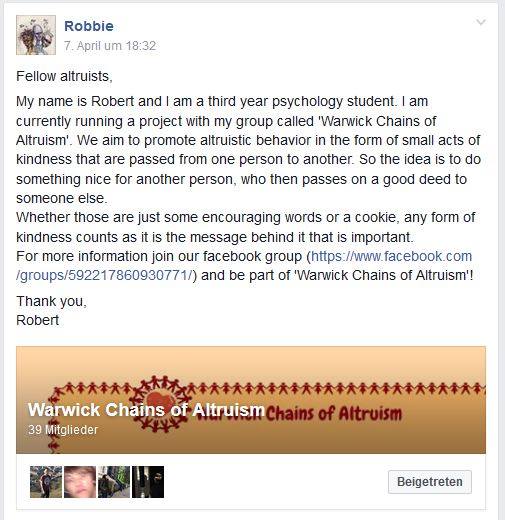 We uploaded a post in the Warwick effective altruism group Webpage: http://warwickchainofaltruism.webstarts.com Facebook group page: https://www.facebook.com/groups/592217860930771/References Post, S. G. (2005). Altruism, happiness, and health: It’s good to be good. International Journal of Behavioral Medicine, 12(2), 66-77.Thoits, P. A., & Hewitt, L. N. (2001). Volunteer work and well-being. Journal of health and social behavior, 115-131.Cindy ChanNickie ChingRobert Jagiello
Library Etiquette: “Don’t do that, it’s not very library-like.”
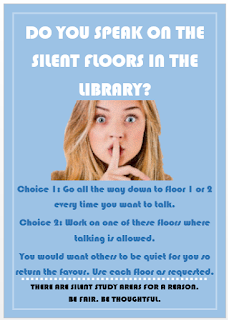
Problem:There are over 23,000 students at the university but only enough facilities for a small fraction (Warwick University, 2015). Seat hogging is therefore a common occurrence in the library, as well as using computer desk spaces for written or laptop work and talking on silent floors. This is inconsiderate and an urgent problem. A change is necessary in order to maximise the availability and efficiency of the limited library space. The upcoming exam period justifies this as talking on silent floors disrupts the learning of students who require silence in order to work efficiently. Further justification resides in the fact that certain courses may require specialist software which are exclusively available on Warwick computers (e.g. SPSS).Solution:Our project aimed to promote ‘library etiquette.’ In an attempt to change the said behaviour, we dispersed posters promoting the proper ‘library etiquette’ – that is, the opposite behaviour to the common problem behaviours exhibited. These posters were placed around the library and within the Psychology common room. They included various persuasive techniques known to be effective in influencing behaviour. Rhetorical questions, social proof and guilt/fear are just three examples of techniques which have been used due to evidence showing their success in influencing behaviour changes (Cialdini, 2009; Burnkrant & Howard, 1984; Dillard & Anderson, 2004).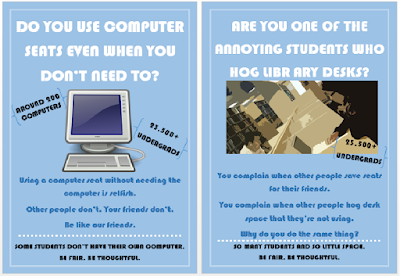
 We also created a Facebook page to share the posters online. This allowed us to reach a wider audience and reinforced the messages we were promoting. This follows the mere exposure effect, a technique which indicates individuals prefer, and are more receptive towards, familiar faces (Zajonc, 2001).
  Group Members: Nazarene Sutherland, Helen Munt & Damola Adebari. ReferencesBurnkrant, R. E., & Howard, D. J. (1984). Effects of the use of introductory rhetorical questions versus statements on information processing. Journal of Personality and Social Psychology, 47, 1218-1230.Cialdini, R. B. (2009). Social Proof: Truth Are Us. Influence: Science and Practice USA: Pearson Education Inc.Dillard, J. P., & Anderson, J. W. (2004). The role of fear in persuasion. Psychology & Marketing, 21,909-926. Warwick University. (2015). Retrieved from https://www2.warwick.ac.uk/about/profile/people/Zajonc, R. B. (2001). Mere exposure: A gateway to the subliminal. Current Directions in Psychological Science, 10, 224-228.
Mindfulness Matters
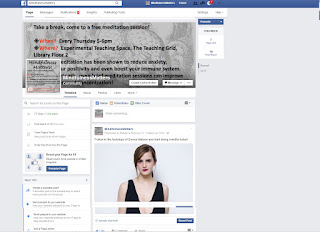 For our project we created a Facebook page, ‘Mindfulness Matters’, to persuade followers to start practicing Mindfulness. Research has shown mindfulness to be effective in many areas, particularly in reducing stress (Brown & Ryan, 2003; Khoury et al., 2013). As university can be a highly stressful time for many people, we felt that educating people on how to practice mindfulness would equip them with the appropriate tools to prevent and deal with stressful periods.
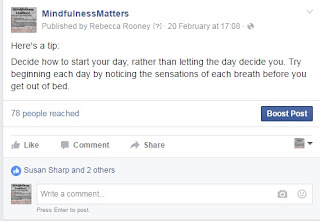 Various tips and posts relating to the topic of mindfulness were posted on this page. Through this page we managed to reach 79 Facebook users and shared useful information about mindfulness with them, which could help them incorporate it into their own lives.
  We also used this page to publicise an upcoming even at the University of Warwick library. This event included a meditation session and a talk about mindfulness which both relate to the stress-release exercises that we previously suggested on our page. We shared the event and promoted it on our page, encouraging students to go and participate in the sessions targeted at reducing anxiety and helping students cope with stress. We had permission from the library staff to do so.
 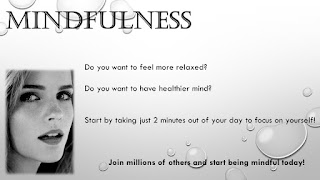 To promote awareness of mindfulness, we created posters which were then stuck up at the University of Warwick library. As is shown above, the poster features an image of celebrity actress, Emma Watson. Our reason for using her image was so that we could increase compliance for mindfulness use through the celebrity endorsement effect. Celebrity endorsement has been shown to increase compliance (Erdogan, 1999) as people often associate perceived characteristics (e.g. likability and attractiveness) of the celebrity with the product (or in this case, mindfulness) being advertised, thus making it more desirable for the audience.
 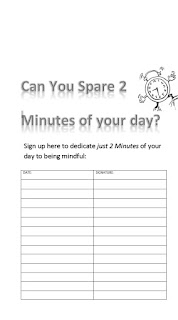 Along with the posters, we also stuck up a sign up sheet, which encouraged people to sign and publicly show their commitment to mindfulness by agreeing to take 2 minutes out of their day to just focus on themselves and their breathing. This was aimed at reducing their stress and anxiety and to help them feel more positive. The sign up sheet makes use of the ‘foot-in-the-door’ technique (Freedman & Fraser, 1966), which suggests that if someone agrees to a small request then they will be more likely to agree to a subsequent larger request. By asking them to comply to a small request of trying out a mindfulness technique for 2 minutes, we hoped that our audience would be more likely to try out mindfulness properly for an extended period of time on their, although we did not measure this. This also incorporates the principle of consistency (Petrova, Cialdini & Sills, 2007), as we hope that people will be more likely to try out mindfulness in the future having signed up and committed to this two minute trial, to remain consistent with their previous behaviour. References:Brown, K. W., & Ryan, R. M. (2003). The benefits of being present: mindfulness and its role in psychological well-being. Journal of personality and social psychology, 84, 822.Erdogan, B. Z. (1999). Celebrity endorsement: A literature review. Journal of marketing management, 15, 291 – 314. Freedman, J. L., & Fraser, S. C. (1966). Compliance without pressure: the foot-in-the-door technique. Journal of personality and social psychology, 4, 195. Khoury, B., Lecomte, T., Fortin, G., Masse, M., Therien, P., Bouchard, V., … & Hofmann, S. G. (2013). Mindfulness-based therapy: A comprehensive meta-analysis. Clinical Psychology Review, 33, 763-771.Pretrova, P. K., Cialdini, R. B., & Sills, S. J. (2007). Consistency-based compliance across cultures. Journal of Experimental Social Psychology, 43, 104-111. By: Navina GandhiRebecca RooneyLiam WardFlorence Cambridge
- « Previous Page
- 1
- …
- 145
- 146
- 147
- 148
- 149
- …
- 562
- Next Page »